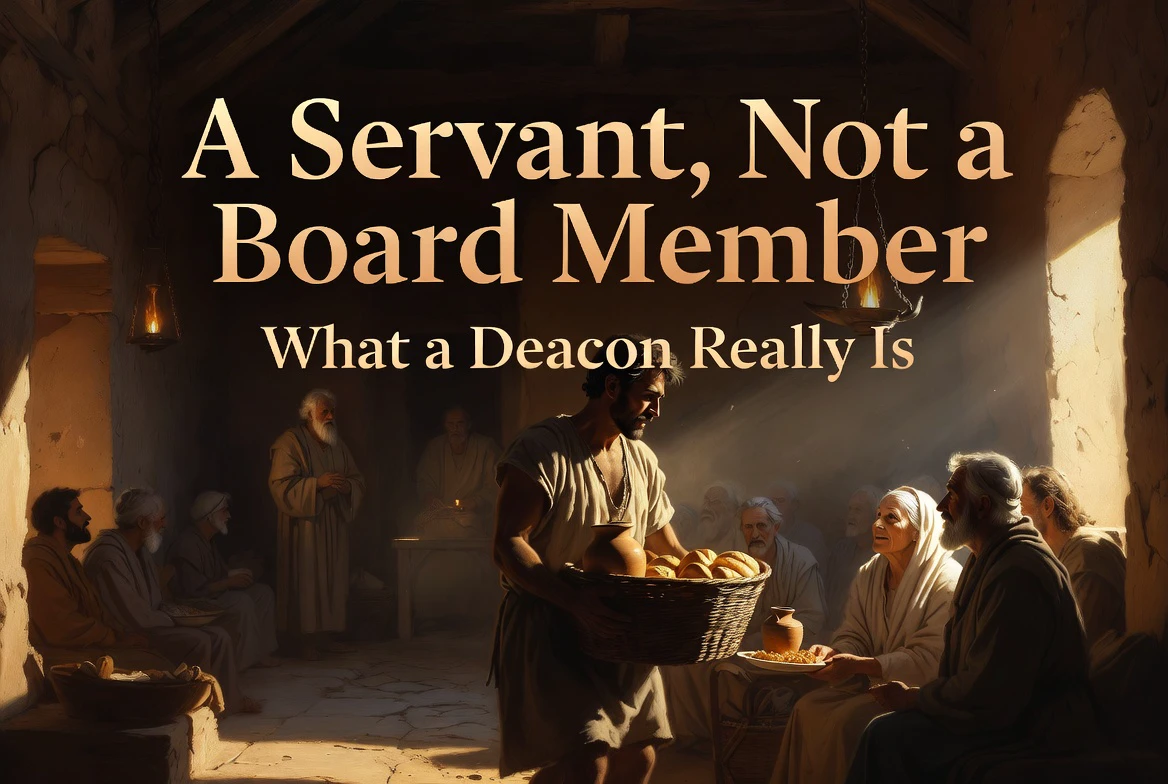
Few church offices have been buried under more tradition than the deacon. In most assemblies a deacon is a board member, a trustee, a man with a vote over the money and the building — and so the office is handed out for worldly standing, deep pockets, or simple agreeableness. Yet when we go to the post-resurrection Scriptures given to the Apostle Paul for the Body of Christ and read what is actually written, almost none of that is there. The word itself means servant, and that is the whole shape of the office. A deacon is a proven, faithful servant-minister of a local assembly — not a teacher, not a ruler, and not a man on a board. And the serving work he formally takes up is the very work we see ordinary saints doing for the churches all through Paul's letters.
Where the Word Appears
The word deacon shows up in only two places in the whole Bible, and both are Paul's, both written to the Body of Christ. The first is a greeting:
"Paul and Timotheus, the servants of Jesus Christ, to all the saints in Christ Jesus which are at Philippi, with the bishops and deacons:" (Philippians 1:1 KJV)
The second is the passage that defines the office, "the office of a deacon" in 1 Timothy 3:8–13. There is no third passage. This matters for rightly dividing: the deacon is a Body office, defined by Paul, not something carried over from Israel's program. The "seven men of honest report" appointed in Acts 6 are never once called deacons in the text, and that scene belongs to the early Acts period before the mystery was made known — it is not the pattern for the church which is His body. If you want to know what a deacon is, you must read Paul, and Paul alone tells you.
A Servant, Not a Board Member
Begin with what the office is not. A deacon is not a trustee, not a treasurer over the funds, not a keeper of the building, and certainly not a man elected for his money or his name in the community. Nor is he a circle of agreeable men gathered to second whatever the pastor proposes. The notion that a deacon is one who has earned a vote — a seat from which to steer the church — has no footing in Scripture at all.
What is left when that baggage is stripped away is the plain meaning of the word: a deacon is a minister, a servant. He is, in the simplest terms, a local minister who is not the bishop. Both the bishop and the deacon are servants of Christ; the difference is that the bishop carries the rule and oversight of the assembly, while the deacon does the serving work of the ministry without that rule over all. That is why Paul opens the deacon's qualifications with one word:
"Likewise must the deacons be grave..." (1 Timothy 3:8 KJV)
Likewise reaches back across the bishop's qualifications in verses 1–7 and lays nearly the same character on the deacon. The standard is the same; the responsibility is different.
The Qualifications (1 Timothy 3:8–13)
To the qualities already required of the bishop, Paul adds a few that mark the deacon in particular:
"Likewise must the deacons be grave, not doubletongued, not given to much wine, not greedy of filthy lucre; Holding the mystery of the faith in a pure conscience." (1 Timothy 3:8–9 KJV)
Grave is weightiness — a man who takes the eternal work seriously, not one who treats it lightly. Not doubletongued is a man who is not duplicitous, who does not speak out of both sides of his mouth or behave one way with one company and another way with the next. Not greedy of filthy lucre is a man who cannot be bought and who can be trusted near the assembly's resources. Then comes "Holding the mystery of the faith in a pure conscience" — and this is worth weighing carefully. It requires the deacon to know and stand fast in the doctrine committed to Paul, the dispensation of the grace of God. It does not say he must preach it; it says he must hold it without wavering and without a divided conscience. Sound doctrine is the root from which all the rest of his conduct grows.
Two further marks govern how a man comes into the office and how it touches his home:
"And let these also first be proved; then let them use the office of a deacon, being found blameless. Even so must their wives be grave, not slanderers, sober, faithful in all things. Let the deacons be the husbands of one wife, ruling their children and their own houses well." (1 Timothy 3:10–12 KJV)
The office is never claimed, requested, or bought — it is proved over time, under real pressure, before it is used. A man's wife and household are part of that proving, because the same faithfulness that orders a home is what orders his service in the church. And the office is "the husband of one wife" — a point we return to below. Paul closes with the reward:
"For they that have used the office of a deacon well purchase to themselves a good degree, and great boldness in the faith which is in Christ Jesus." (1 Timothy 3:13 KJV)
This "good degree" cannot be bought with money, seniority, or favor. It is earned by good service flowing from good doctrine, and it is plain for all to see — no ceremony confers it and no roster records it.
Why This Is Not a Teaching Office
Read the deacon's qualifications beside the bishop's and one thing stands out at once. Of the bishop Paul requires that he be "apt to teach" (1 Timothy 3:2), and of the elder he requires the same gift more fully:
"Holding fast the faithful word as he hath been taught, that he may be able by sound doctrine both to exhort and to convince the gainsayers." (Titus 1:9 KJV)
That requirement is given exactly where teaching is the work — and it is conspicuously absent from the deacon. Paul lays no teaching demand on the deacon at all. If the deacon's office were a teaching office, that silence would make no sense; Paul puts the teaching qualification where teaching belongs and withholds it where it does not.
This is also why "Holding the mystery of the faith in a pure conscience" must not be read as a teaching mandate. To hold the faith is to know it, believe it, and not let it go; it is not the same as standing up to proclaim it. A man may be required to be doctrinally solid without his office being a pulpit. The teaching and ruling weight rests on the bishop; the deacon is the proven, faithful servant who carries the practical work of the ministry under him. The character Paul actually describes — grave, trustworthy in word, trustworthy with money, proved, faithful — is the profile of a man you would entrust with the assembly's real service, not the profile of its teacher.
A related word should be cleared up here, since it is often pressed into the deacon's office where it does not belong. Scripture does speak of elders ordained in the churches (Acts 14:23; Titus 1:5), but it ties that word to the bishop, never to the deacon. In Titus, Paul tells him to "ordain elders in every city" and within the same charge grounds it in the bishop: "For a bishop must be blameless..." (Titus 1:5, 7) — the elder he ordains is the bishop. So again in the other epistle to a fellow-worker: "Let the elders that rule well be counted worthy of double honour, especially they who labour in the word and doctrine" (1 Timothy 5:17) — elders marked by ruling and by the word, which is the bishop's work, not the deacon's. And in the very chapter that defines the deacon, Paul never once calls him an elder. The term belongs to the ruling, teaching office; there is no warrant to read it into the office of a deacon.
The Seven of Acts 6: A Kindred Service Under a Different Program
Tradition reaches back past Paul to Acts 6 for its pattern, where the twelve set seven men over the care of the neglected widows so the apostles could keep to their own work:
"...It is not reason that we should leave the word of God, and serve tables. Wherefore, brethren, look ye out among you seven men of honest report, full of the Holy Ghost and wisdom, whom we may appoint over this business. But we will give ourselves continually to prayer, and to the ministry of the word." (Acts 6:2–4 KJV)
There are two reasons this is not the deacon's charter. First, as already noted, the word deacon is never used of these men, and the scene stands in the early Acts period, inside Israel's kingdom program, before the mystery was made known. Second — and this is the part worth examining — the very qualification the twelve required cannot be carried straight across into the Body.
The seven had to be men "full of the Holy Ghost and wisdom" (Acts 6:3); Stephen is named "a man full of faith and of the Holy Ghost" (Acts 6:5), who then "did great wonders and miracles among the people" (Acts 6:8) and, full of the Holy Ghost, saw heaven opened (Acts 7:55–56), and Philip likewise worked miracles in Samaria (Acts 8:6). Under Israel's program this was a real, observable, selective endowment. The Spirit had been promised to that nation by covenant, to be poured out so Israel could keep its new covenant, and being "full of the Holy Ghost" set certain men apart from the rest, marked by power and by signs. That is why the twelve could tell the multitude to look out among them for such men: not everyone was so filled, and the filling could be seen.
Under the mystery it is altogether different. The Spirit is not a selective endowment marking out some servants from others; He is given to every believer the moment he believes:
"...in whom also after that ye believed, ye were sealed with that holy Spirit of promise," (Ephesians 1:13 KJV)
Every member of the Body is indwelt — "if any man have not the Spirit of Christ, he is none of his" (Romans 8:9) — and all alike were "by one Spirit... baptized into one body" (1 Corinthians 12:13). So "full of the Holy Ghost" cannot serve as a qualification that distinguishes a deacon from any other saint; every saint already has the Spirit, fully and permanently.
A distinction must be kept here, for Scripture speaks of the Spirit in two ways that are easy to confuse. The believer is sealed with the Spirit once, at the moment of faith, and that indwelling is positional, universal, and permanent; it is not felt, earned, or increased — it simply is, from the instant one believes the gospel. But Paul also commands a second thing, a matter of the daily walk: "And be not drunk with wine, wherein is excess; but be filled with the Spirit;" (Ephesians 5:18). To be filled in this sense is not to receive more of the Spirit than another believer has; it is to yield the control of one's life to the Spirit one already possesses. The very next words are the walk itself — "Speaking to yourselves in psalms and hymns and spiritual songs..." (Ephesians 5:19) — and Paul puts the same truth plainly elsewhere: "Walk in the Spirit, and ye shall not fulfil the lust of the flesh" (Galatians 5:16). It is the opposite of being governed by appetite, which is exactly why Paul sets it over against drunkenness. So there is an Ephesians 5:18 filling under the mystery — but notice what it is and is not. It is not a one-time, evidential endowment that marks some believers out from others by signs and power, as in Acts; it is a daily yielding commanded of every believer alike. It therefore gives no more of a selection mark for officers than the indwelling does. Indeed, the deacon's own qualification quietly echoes it: a man "not given to much wine" (1 Timothy 3:8) is a man already learning to be governed by the Spirit rather than by the bottle — the very walk Ephesians 5:18 lays on all. What Acts 6 looked for, then — the visible filling that set certain men apart — has no counterpart in the mystery: neither the indwelling that all believers share, nor the filling that all are commanded to pursue, singles out a deacon.
And this is exactly what we find in Paul's deacon qualifications: he does not say "full of the Holy Ghost" as Acts 6 did. In its place he sets "Holding the mystery of the faith in a pure conscience" (1 Timothy 3:9) and proven, faithful character. The qualification shifted because the program shifted: where Israel looked for the visible filling of the Spirit, the Body looks for soundness in the mystery and a life proved over time.
So Acts 6 cannot define the deacon, and the seven were not deacons of the Body. Yet — and only as a very soft confirmation — the shape of their service is a kindred picture. Their task was the plainest kind of practical care: the "daily ministration" to widows whose physical needs were being neglected, the serving of tables (Acts 6:1–2), so that the ministry of the word could go forward unhindered. That ministering to the bodily needs of the assembly is genuine ministry, and it sits comfortably beside the servant function we trace in Paul. We do not build the office on Acts 6; we simply note that the serving of physical needs there is consistent with the servant the post-resurrection Scriptures describe.
The Servant Function Across Paul's Epistles
Once we are looking for the function rather than the title, Paul's letters prove full of it — saints serving and ministering to the assemblies, and almost none of them called teachers. The clearest parallel to the deacon principle is the house of Stephanas:
"ye know the house of Stephanas, that it is the firstfruits of Achaia, and that they have addicted themselves to the ministry of the saints, That ye submit yourselves unto such, and to every one that helpeth with us, and laboureth." (1 Corinthians 16:15–16 KJV)
No one appointed them to a board; they addicted themselves to serving the saints, and because they proved it, the assembly is told to submit to them. Of the same men Paul adds, "they have refreshed my spirit and yours: therefore acknowledge ye them that are such" (1 Corinthians 16:18). That is the deacon principle exactly: proven service, then recognition.
The same serving function appears in name after name. Phebe is "a servant of the church which is at Cenchrea" and "a succourer of many, and of myself also" (Romans 16:1–2). Onesiphorus "oft refreshed me, and was not ashamed of my chain", and Paul recalls "in how many things he ministered unto me at Ephesus" (2 Timothy 1:16, 18). Tychicus is "a beloved brother, and a faithful minister and fellowservant in the Lord" (Colossians 4:7). Epaphras is "a faithful minister of Christ" who labors for the saints in prayer, "always labouring fervently for you in prayers, that ye may stand perfect and complete in all the will of God" (Colossians 1:7; 4:12). Archippus is charged simply, "Take heed to the ministry which thou hast received in the Lord, that thou fulfil it" (Colossians 4:17) — a ministry to discharge, not a title to wear.
The catalog in Romans 16 is a roll of servants: Priscilla and Aquila, "my helpers in Christ Jesus" who "have for my life laid down their own necks" (16:3–4); Mary, "who bestowed much labour on us" (16:6); Urbane, "our helper in Christ" (16:9); "Tryphena and Tryphosa, who labour in the Lord" and "the beloved Persis, which laboured much in the Lord" (16:12); and Gaius, "mine host, and of the whole church" (16:23). Paul names the women of Philippi too, "those women which laboured with me in the gospel" (Philippians 4:3).
Epaphroditus belongs in this company, and his case is especially striking:
"Yet I supposed it necessary to send to you Epaphroditus, my brother, and companion in labour, and fellowsoldier, but your messenger, and he that ministered to my wants... Because for the work of Christ he was nigh unto death, not regarding his life, to supply your lack of service toward me." (Philippians 2:25, 30 KJV)
Here is pure, sacrificial, practical service — a man who "ministered to my wants" and nearly died doing the work. And he is likely more than that. Paul calls him the Philippians' own "messenger", and the word the King James gives there as messenger is the same it gives elsewhere as apostle; he may fairly be reckoned an apostle of the Body in that sense — and a Gentile one, with no part whatever in Israel's kingdom company. (This is taken up in the companion study, Did Any Remnant Believer Cross Into the Body of Christ?) The point only sharpens the lesson: even a sent-one of the Body, even one who may be reckoned an apostle, is found ministering to another's wants. The serving function is not beneath the highest gifts; it crowns them.
The Weight of the Trust: Why Fidelity Matters
Now the qualifications of 1 Timothy 3 come into sharper focus. A deacon is not a man who studies in a corner; he is a servant in constant contact with the assembly — entering its homes, handling its gifts, carrying its care to the weak. The seven of Acts 6 were set over the food of neglected widows; Epaphroditus carried the Philippians' gift and ministered to Paul's wants; Phebe was a succourer of many; Gaius hosted the whole church. This is work done close to people and close to their resources — and that is precisely why Paul screens so carefully for character. A faithless servant in such a place can do great harm to the very ones he is set to help.
Read the qualifications in that light and they stop looking like a generic list of virtues. That a deacon be "not greedy of filthy lucre" (1 Timothy 3:8) guards a man who will be near the assembly's money; let him love it, and the widows go hungry while he is fed. That he be "not doubletongued" guards a man who moves among many households; let him carry one home's confidences to another, and he sows division through the very access his service grants him. That he be "grave" marks a man who will not trifle with a trust that touches people's needs. Even his wife must be "faithful in all things" (1 Timothy 3:11), for she shares that same nearness to the homes and the confidences of the saints. The standard is high because the harm is real, and it falls hardest on the weakest — the widows, the needy, the very people Scripture tells the church to "Honour" (1 Timothy 5:3).
Paul felt this weight himself in the plainest possible matter, the handling of the churches' money. When he carried the collection for the poor saints at Jerusalem he would not touch it alone, and — whatever the gift's occasion — the principle of his care is plain:
"Avoiding this, that no man should blame us in this abundance which is administered by us: Providing for honest things, not only in the sight of the Lord, but also in the sight of men." (2 Corinthians 8:20–21 KJV)
If the apostle would not handle the saints' gifts without visible, demonstrable integrity, how much more the local servant entrusted with the same. This is the fidelity the post-resurrection Scriptures require of every steward — "it is required in stewards, that a man be found faithful" (1 Corinthians 4:2) — and Paul names it by that very word when he charges servants to be "Not purloining, but shewing all good fidelity; that they may adorn the doctrine of God our Saviour in all things" (Titus 2:10). A deacon adorns the doctrine when his service can be trusted; he disgraces it when it cannot. The faithfulness is no formality — it is the safeguard of the very people he is sent to serve.
Recognition by Proof, Not Appointment
Notice how Paul tells the assemblies to respond to these servants. Of Stephanas: "submit yourselves unto such" and "acknowledge ye them that are such" (1 Corinthians 16:16, 18). Of Epaphroditus: "Receive him therefore in the Lord with all gladness; and hold such in reputation" (Philippians 2:29). And of laboring men generally:
"And we beseech you, brethren, to know them which labour among you, and are over you in the Lord, and admonish you; And to esteem them very highly in love for their work's sake." (1 Thessalonians 5:12–13 KJV)
This is the same thing Paul says of the deacon: "let these also first be proved", and those who serve well "purchase to themselves a good degree". The honor follows the work that the assembly can see. There is no campaign, no ceremony, no list of names — only proven servants whom the saints come to esteem for their work's sake. The same passage reaches toward the bishop as well, naming those who "are over you in the Lord, and admonish you"; the honor it commands rightly covers all who labour, deacon and bishop alike.
The Function for Every Saint, the Office for a Qualified Man
One more thing the survey makes plain. Many of these proven servants are women — Phebe, Mary, Priscilla, Tryphena, Tryphosa, Persis, the laboring women of Philippi. Serving the saints is the calling of every member of the Body; ministry in that broad sense is open to all. But the recognized office of a deacon is not, for Paul defines it as "the husband of one wife" (1 Timothy 3:12). Nor does the verse before it open a separate order of women: some would read "Even so must their wives be grave..." (1 Timothy 3:11) as "women," and make it a roster of female deacons. But on the text we hold, the King James reads "their wives" — these are the deacons' own wives, set beside their husbands within verses 8–12, not a female office; and with verse 12 the door is shut from both sides. Even Phebe, whom the King James calls a "servant of the church" (Romans 16:1) — the very word it renders deacon elsewhere — is given the service, never the office. The reason is not that women are less able — Phebe and these laboring women prove otherwise — but that the office is bound to a responsibility Paul assigns to the husband. The deacon must be a man "ruling their children and their own houses well" (1 Timothy 3:12); the office rests on the same household headship that belongs to the man as husband, and to set a woman in it would unsettle in the church the very order God set in the home. It is a matter of God-given role, not of capability. The distinction is clean and worth keeping: the servant function belongs to the whole body; the office of a deacon is that function formally recognized in a qualified man of the local assembly.
There is a further mark of the same distinction, easily missed: the office of a deacon is never listed among the gifts Christ gave to His body. When Paul names the gifted men the ascended Lord gave the Body, they are all men of the word — "And he gave some, apostles; and some, prophets; and some, evangelists; and some, pastors and teachers; For the perfecting of the saints, for the work of the ministry, for the edifying of the body of Christ" (Ephesians 4:11–12). There is no deacon in that list, just as there is none among "first apostles, secondarily prophets, thirdly teachers" (1 Corinthians 12:28). The serving itself does appear among the gifts — Paul names "ministry", "he that giveth", and "he that sheweth mercy" (Romans 12:7–8), and "helps" (1 Corinthians 12:28) — but the office of a deacon is not a gift at all. This confirms what we have seen throughout: a gift is distributed by the Spirit as He will and worked out by every member, while an office is a recognized responsibility entrusted to a proved and qualified man. A believer may have the gift of ministering or of showing mercy and never hold the office; and the man who holds the office holds no gift the office itself confers — only the public recognition of, and responsibility for, a service he has already proved. The deacon, then, is neither a teaching gift-man given for the Body's foundation and edifying, nor a special endowment of the Spirit; he is a faithful servant, formally acknowledged.
What, Then, Is a Deacon?
A deacon is the trustworthy, proven servant-minister of a local church: grave, single-tongued, free from the love of money, sound in the mystery of the faith, faithful at home, and tested over time. He is not a teacher and not a ruler — those belong to the bishop — and he is certainly not a board member with a vote. He is the serving work of saints like Stephanas, Phebe, and Epaphroditus, formally taken up and recognized in a qualified man. Paul defines the man, not a list of duties; and the man he defines is, from first to last, a servant. Where doctrine is sound and grace is understood, such men are not appointed by ballot but recognized by their work — and the assembly is told simply to acknowledge them, hold them in reputation, and esteem them very highly in love for their work's sake.
See also: Rightly Dividing Church Leadership: The Bishop, the Elder, and the Pastor — the ruling office in full: one office under four names (bishop, elder, overseer, pastor), its qualifications and work, and whether Paul teaches ordination.
© 2026 Edward R. Cross





Comments
No comments yet. Be the first to share your thoughts.
Leave a comment