You explain that the believer is saved by grace through faith apart from works, complete in Christ, kept by the power of God. And almost before you finish, it comes: "But Jesus said…" — followed by a verse in red, produced like a trump card that ends the conversation. The unspoken assumption is that the words of the Lord Jesus, printed in red, outrank anything written by the apostle Paul. After all, who is Paul next to the Lord Himself?
It is a powerful reflex, and it deserves a real answer. The answer is not to dismiss what Jesus said — every word He spoke is the inspired word of God — but to ask the question the reflex skips over. The question is never whether Jesus said it. He did. The question is to whom He said it, and under what program. Once you learn to ask that one question, the trump card turns out to be no trump at all, and you can honor every word the Lord spoke while still rightly dividing the word of truth (2 Timothy 2:15). This study gives you that question, and then walks it through the verses you will actually hear quoted.
The Reflex, and Why It Carries Such Force
The reflex is fed by two things. The first is reverence — a right instinct that the Saviour's own words must surely carry more weight than an apostle's, so that quoting Jesus feels like playing the highest card in the deck. The second is the red-letter Bible itself, which prints Christ's words in a different color and trains the eye to treat them as a class apart. But the red ink is a printer's decision from the late nineteenth century, not a mark of inspiration; the words of Paul are no less the words of the risen Christ than the words spoken in Galilee. Reverence for Christ is not the problem. Reverence for Christ is exactly the reason we must take care to hear which of His words were spoken to whom — because He did not say the same things to the same people for the same purpose in every age.
One Question Settles Most of Them: To Whom, and Under What Program?
Here is the question to ask of any red-letter verse someone hands you: to whom was the Lord speaking, and under which of God's programs? Scripture answers plainly for His earthly ministry. He told us its scope in His own words:
"I am not sent but unto the lost sheep of the house of Israel." (Matthew 15:24 KJV)
And Paul tells us its purpose:
"Now I say that Jesus Christ was a minister of the circumcision for the truth of God, to confirm the promises made unto the fathers." (Romans 15:8 KJV)
The Lord Jesus in His earthly life was a minister of the circumcision — sent to Israel, confirming the covenant promises made to her fathers. He was "made under the law" (Galatians 4:4 KJV), and He ministered under it. In fact the old covenant was still in force the whole time He walked the earth, for Scripture says a testament takes effect only at the death of the one who made it:
"For where a testament is, there must also of necessity be the death of the testator. For a testament is of force after men are dead: otherwise it is of no strength at all while the testator liveth." (Hebrews 9:16-17 KJV)
That means the words of Christ in His earthly ministry were spoken while Israel was still under the old covenant, to Israel, within her prophetic kingdom program. Paul marks the dividing line for us:
"Wherefore henceforth know we no man after the flesh: yea, though we have known Christ after the flesh, yet now henceforth know we him no more." (2 Corinthians 5:16 KJV)
So the diagnostic is simple, and you can run it on any verse in red: Who is being addressed — Israel or the Body of Christ? Under what program — the kingdom promised to the fathers, or the mystery revealed to Paul? Before the mystery was made known, or after? Does Paul, writing to us, confirm this as our rule, or does he say something different? Nine times out of ten, the moment you ask to whom, the supposed contradiction simply dissolves into a dispensational distinction.
One clarification before we apply it. Answering "but Jesus said" with a word from Paul is not pitting a man against the Master, for Paul's epistles are the commandments of the risen Christ for this age — "the things that I write unto you are the commandments of the Lord" (1 Corinthians 14:37 KJV) — received by direct revelation from the ascended Lord (Galatians 1:11-12). That whole case is made in "Following Paul Is Following Christ"; here we simply assume it and put it to work. So "I follow Jesus, not Paul" has a one-line answer — Jesus sent Paul — and with that settled, we can take up the verses themselves.
"Sell all that thou hast" — The Rich Young Ruler
The objection: Jesus told a man to sell everything he owned, so material sacrifice must be a condition of following Him. But look at who asked, and what he asked:
"Good Master, what good thing shall I do, that I may have eternal life?" (Matthew 19:16 KJV)
A man under the law asks how to do something to earn life, and the Lord meets him precisely on that ground: "if thou wilt enter into life, keep the commandments" (Matthew 19:17 KJV). Only then comes the command to sell:
"If thou wilt be perfect, go and sell that thou hast, and give to the poor, and thou shalt have treasure in heaven: and come and follow me." (Matthew 19:21 KJV)
This is a kingdom term of entry, spoken on law-ground to an Israelite who insisted on a doing-religion — exposing that he loved his goods more than God. It is not the gospel Paul preaches to the Body of Christ, where salvation is explicitly not a thing done:
"For by grace are ye saved through faith; and that not of yourselves: it is the gift of God: Not of works, lest any man should boast." (Ephesians 2:8-9 KJV)
"But to him that worketh not, but believeth on him that justifieth the ungodly, his faith is counted for righteousness." (Romans 4:5 KJV)
We are never told to sell all we have to be saved, because salvation is a gift, not a wage. Paul does teach generous, cheerful giving — but as the grateful response of the already-saved, never as the price of life.
"Treasure in Heaven": Reserved Above, Inherited on the Earth
The same verse holds a second, deeper proof. The Lord did not offer the young man heaven instead of earth; He offered him "treasure in heaven" — reward laid up above and reserved for him, of a piece with the same Sermon He preached to Israel: "lay up for yourselves treasures in heaven, where neither moth nor rust doth corrupt" (Matthew 6:20 KJV). For the kingdom saint, treasure in heaven does not mean a destiny in heaven. It is an inheritance kept safe above — "reserved in heaven for you" (1 Peter 1:4 KJV) — to be brought to him in the end; for his hope is emphatically earthly: "Blessed are the meek: for they shall inherit the earth" (Matthew 5:5 KJV). When Scripture calls this inheritance heavenly, it names its origin and its safekeeping — not a disembodied home in the sky.
And that inheritance comes to Israel in two stages, both of them on the earth. First the kingdom. At the resurrection of the just the faithful are raised to enter what the patriarchs sought but never received in life (Hebrews 11:13, 39), and they reign with Christ over the restored earth — "they shall be priests of God and of Christ, and shall reign with him a thousand years" (Revelation 20:6 KJV). This is the thousand-year reign promised to the meek who shall inherit the earth. Then the city. Abraham had looked beyond even the kingdom, for "a city which hath foundations, whose builder and maker is God" (Hebrews 11:10 KJV) — a city God "hath prepared for them" (Hebrews 11:16 KJV), and which the remnant still awaited: "here have we no continuing city, but we seek one to come" (Hebrews 13:14 KJV). After the thousand years, when the first heaven and earth are passed away, that city descends at last to the new earth:
"And I saw a new heaven and a new earth: for the first heaven and the first earth were passed away... And I John saw the holy city, new Jerusalem, coming down from God out of heaven, prepared as a bride adorned for her husband." (Revelation 21:1-2 KJV)
So the kingdom saint's "treasure in heaven" is reserved above now, received at the resurrection of the just when he inherits the earth in the kingdom, and consummated when the heavenly city comes down to the new earth — heavenly in its safekeeping, earthly in its destination, from the first stage to the last. Even the reward Christ held out to the rich young ruler runs along Israel's line, not the Body's.
For the contrast could not be plainer. The Body of Christ does not wait for treasure to be carried down to an inheritance on the earth, nor for a city to descend. We are already "blessed... with all spiritual blessings in heavenly places in Christ" (Ephesians 1:3 KJV) and already "made... sit together in heavenly places in Christ Jesus" (Ephesians 2:6 KJV) — seated far above the city that comes down, not dwelling within it. The kingdom saint's treasure descends to him; the member of the Body is already raised up. Two inheritances, two directions, two programs — and "treasure in heaven" belongs to the first.
"Judge not, that ye be not judged"
The objection — the most-quoted verse in the world — is that Jesus forbade all judging, so the believer must never evaluate anyone's doctrine or conduct.
"Judge not, that ye be not judged." (Matthew 7:1 KJV)
Two answers. First, even in its own context the verse does not forbid all discernment; it forbids hypocritical and measuring judgment — the man with a beam in his own eye picking at the mote in his brother's (Matthew 7:2-5). Second, and decisively, Paul positively commands the Body of Christ to judge doctrine and conduct within the assembly:
"For what have I to do to judge them also that are without? do not ye judge them that are within?" (1 Corinthians 5:12 KJV)
"But he that is spiritual judgeth all things, yet he himself is judged of no man." (1 Corinthians 2:15 KJV)
Paul even prays that our love would grow in discernment, "that ye may approve things that are excellent" (Philippians 1:10 KJV). What Scripture withholds from us is the judging of hidden motives and final faithfulness, which belongs to Christ at His coming — the balance worked out in "Judge Nothing Before the Time." We are to judge what is visible; we are not to play God over what is hidden.
"Lord, Lord… I never knew you"
The objection is used to make salvation hinge on performance, and to shake the assurance of people who are trusting Christ:
"Not every one that saith unto me, Lord, Lord, shall enter into the kingdom of heaven; but he that doeth the will of my Father which is in heaven." (Matthew 7:21 KJV)
"And then will I profess unto them, I never knew you: depart from me, ye that work iniquity." (Matthew 7:23 KJV)
Notice the setting: entering the kingdom of heaven, by doing the will of the Father, with false prophets in Israel pointing to their mighty works (Matthew 7:22). This is the kingdom-sermon standard pressed upon the nation — entrance measured by doing. It is not the standing of the Body of Christ, where we are saved by grace, sealed by the Spirit, and — far from being unknown to Him — are known by God:
"But now, after that ye have known God, or rather are known of God…" (Galatians 4:9 KJV)
The members of the Body do not stand before Christ as strangers hoping their works pass muster. We stand "complete in him" (Colossians 2:10 KJV), with "no condemnation" (Romans 8:1 KJV). Matthew 7 is a real and terrible warning — in its place, to its people.
"He that shall endure unto the end shall be saved"
The objection: salvation must be kept by endurance.
"But he that shall endure unto the end, the same shall be saved." (Matthew 24:13 KJV)
The context is the tribulation Israel will pass through before the kingdom comes (Matthew 24). Endurance-to-the-end salvation belongs to that program, where the promise is future and can be forfeited. It is the very opposite of the Body's standing, sealed "unto the day of redemption" (Ephesians 4:30 KJV). The endurance language of the Gospels and the Hebrew epistles is addressed to a people whose salvation lay ahead of them — a distinction worked out at length in "Who Was the Book of Hebrews Written To?".
Two You'll Hear Often — Already Answered at Length Elsewhere
Two of the most common red-letter objections run exactly the same way, and both are treated in full in "Following Paul Is Following Christ"; I name them here only to show the method holds. The first is conditional forgiveness — "if ye forgive not men their trespasses, neither will your Father forgive your trespasses" (Matthew 6:15 KJV) — which was Israel's prayer under a covenant of conditions; Paul reverses the order for the Body, who forgive because already forgiven all trespasses in Christ (Ephesians 4:32; Colossians 2:13). The second is the Great Commission — "Go ye therefore, and teach all nations, baptizing them... Teaching them to observe all things whatsoever I have commanded you" (Matthew 28:19-20 KJV) — the kingdom commission to the Twelve, including the keeping of the law (Matthew 5:19), given before the mystery; Paul received a later and greater commission, the ministry of reconciliation (2 Corinthians 5:18), and could say "For Christ sent me not to baptize, but to preach the gospel" (1 Corinthians 1:17 KJV). Same question, same result: each one lands in its place.
The Method Scales to Every "But Jesus Said"
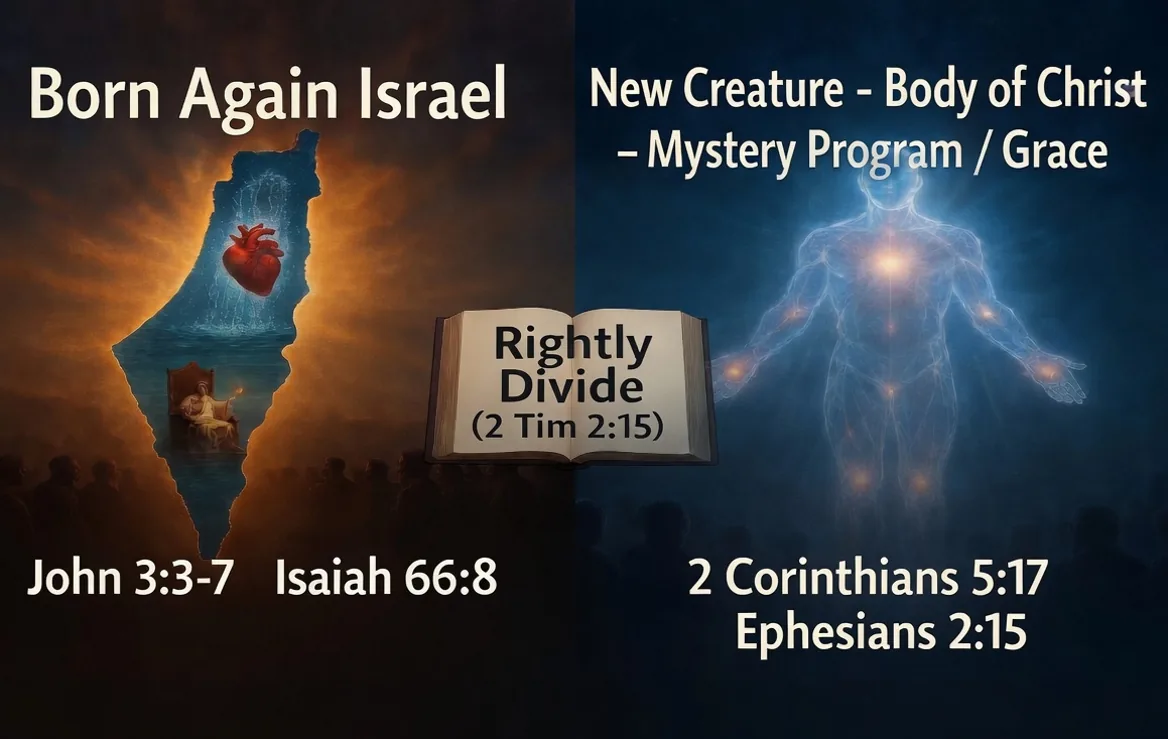
Once the question becomes second nature, it answers the rest as fast as they are raised. The call to "take up his cross, and follow me" (Matthew 16:24 KJV) is the cost of kingdom discipleship pressed on Israel, not the terms of grace. "Ye must be born again" (John 3:7 KJV) is Israel's promised national regeneration, spoken to a master of Israel — the Body's truth is the new creature in Christ ("Born Again, Born of the Spirit, and Born After the Spirit" works this out). The hellfire warning for calling a brother "Thou fool" (Matthew 5:22 KJV) is kingdom-law sentencing, not a rule over the sealed Body (see "Thou Fool"). In every case the move is identical: ask to whom and under what program the Lord spoke, and let Paul tell you what is true of the Body of Christ today.
When Jesus' Words Are Also for Us
Right division does not throw the red letters away, and we must never give that impression. The Lord Jesus revealed the Father, displayed the heart of God, foretold His own death and resurrection, and spoke truths that Paul himself echoes. We read the Gospels with reverence and profit, for "all scripture is given by inspiration of God, and is profitable" (2 Timothy 3:16 KJV). The point is not that Christ's earthly words are less precious; it is that they are not all addressed to us as our rule of life. We do not reject a single word the Lord spoke. We simply locate it — and a word rightly located is a word rightly honored.
Why This Matters
The red-letter reflex is not defeated by cleverness; it is dissolved by rightly dividing. And the goal is not to win an argument but to free people — the one who quoted the verse, and you yourself — to stop straining under commands never given to the Body of Christ and to rest in the finished work of the cross. The believer who has learned the one question no longer flinches when the trump card is played. He simply asks, kindly, to whom was the Lord speaking, and under what program? — and follows the answer.
So the next time you hear "but Jesus said…," do not retreat, and do not dismiss the Lord's words. Honor them, place them, and answer from the apostle Christ raised up to speak for Him in this age:
"Wherefore I beseech you, be ye followers of me." (1 Corinthians 4:16 KJV)
Following Paul is following Christ. Keep rightly dividing.
© 2026 Edward R. Cross





Comments
No comments yet. Be the first to share your thoughts.
Leave a comment