In companion studies we asked whether a member of the Body of Christ must come to a throne of grace to obtain mercy, and whether he has, or needs, a High Priest. The answer in each case was no — not because Christ is any less glorious to us, but because the relationship Paul reveals between the Body and her Head is of a different order than the one Israel sustains to her Messiah. Now a third title from the same family presses for the same examination. Christendom loves to picture the Lord Jesus standing before the Father as our Advocate, pleading our case, answering the accusations brought against us, keeping us in favor by His continual intercession at the bar. It is a tender picture. But is it the Body's picture?
The honest answer, when Paul's revelation governs our understanding of our own standing, is again no. The Body of Christ does not need an Advocate — and seeing why is no cold technicality. It goes to the very root of our assurance.
"Advocate" Appears Once — and Not in Paul
Begin where the word itself begins. The title "advocate," applied to Christ, occurs exactly one time in all of Scripture:
"My little children, these things write I unto you, that ye sin not. And if any man sin, we have an advocate with the Father, Jesus Christ the righteous." (1 John 2:1 KJV)
That is John's word, not Paul's. As with "high priest," Paul — who was given the revelation of the mystery for the Body of Christ — never once calls Christ our Advocate, in any of his thirteen epistles. He names Christ our Head, our life, our Saviour, our one Mediator; he never stations Him at a bar pleading our defense. The single appearance of the word, and the man who wrote it, should make us look carefully before we drape the title over the Body.
What an Advocate Is — and What It Implies
An advocate is one who stands and pleads another's cause. The office exists for the courtroom: a charge is laid, and an advocate rises to answer it on the client's behalf. And notice the setting John gives it — "if any man sin, we have an advocate." The advocacy is joined to sinning; it is the help that meets a believer when his sin brings a charge against him. That is an ongoing ministry, exercised again and again as occasion arises, and it presupposes a particular kind of standing — a standing that sin can disturb, that can be charged, that must be answered for and kept.
Hold that up against what Paul says is true of the Body, and the ground shifts entirely.
The Body's Standing Is Settled and Sealed
The member of the Body of Christ does not hold a standing that hangs in the balance, waiting on a plea. His standing was settled the moment he believed and sealed against the day of redemption:
"...wherein he hath made us accepted in the beloved." (Ephesians 1:6 KJV)
"And grieve not the holy Spirit of God, whereby ye are sealed unto the day of redemption." (Ephesians 4:30 KJV)
Accepted, complete, forgiven all trespasses, sealed by the Spirit until redemption is complete — this is a finished and present possession, not a verdict still being argued. And because it is finished, there is simply no charge left for an advocate to answer. Paul puts the courtroom itself out of session:
"Who shall lay any thing to the charge of God's elect? It is God that justifieth. Who is he that condemneth? It is Christ that died, yea rather, that is risen again, who is even at the right hand of God, who also maketh intercession for us." (Romans 8:33–34 KJV)
Mark the form of it. Paul does not say, "when a charge is laid, an advocate will answer it." He says no charge can be laid at all, because the Judge Himself has justified us:
"There is therefore now no condemnation to them which are in Christ Jesus, who walk not after the flesh, but after the Spirit." (Romans 8:1 KJV)
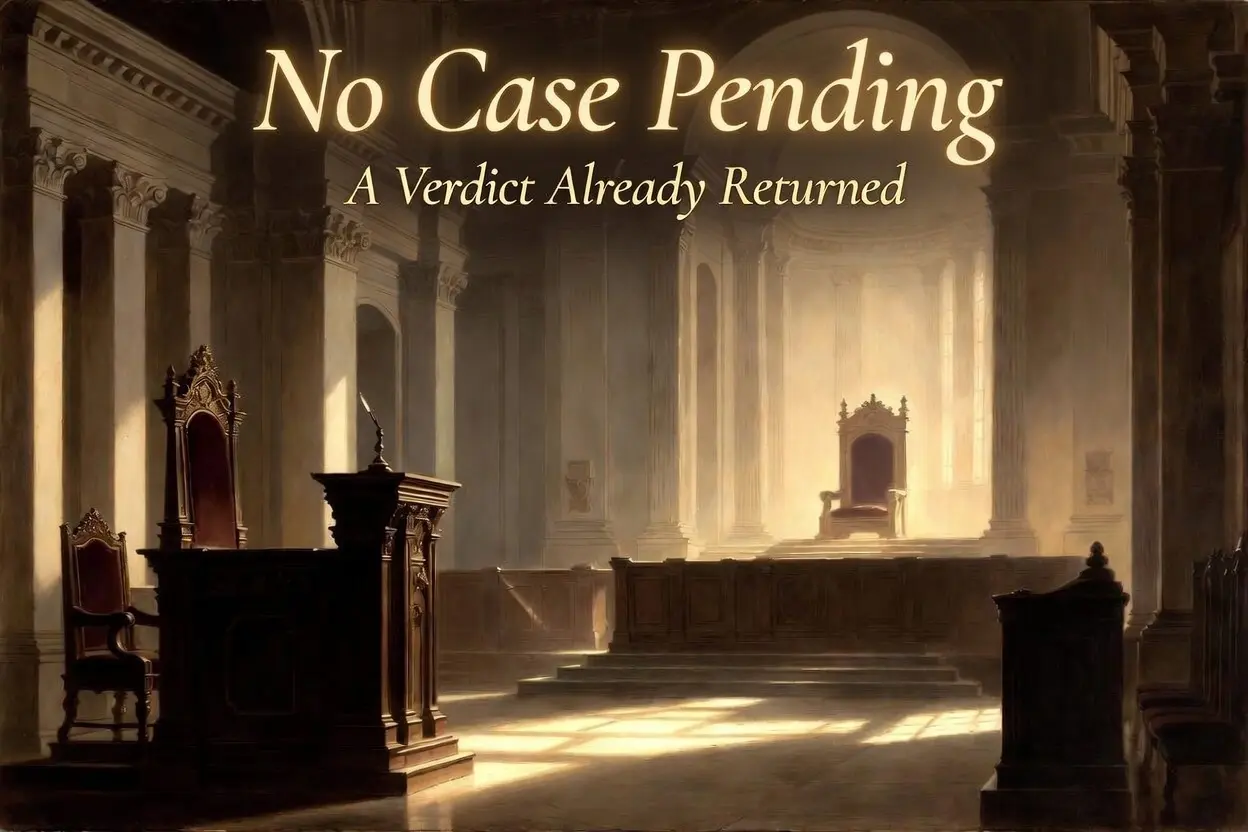
That closing line names our position, not a probation. To be "in Christ Jesus" is to be indwelt and sealed by the Spirit — no longer standing before God in the flesh, but in the Spirit; the walk "after the Spirit" describes who we now are in Him, not a standard we must keep to escape condemnation. The sentence of "no condemnation" is pronounced over everyone who is in Christ. An advocate answers accusations; Paul declares the accusations impossible. The one assumes a trial in progress; the other announces a verdict already returned.
But Is Not Satan the Accuser of the Brethren?
Here the strongest form of the objection arrives, for the Advocate of 1 John is almost always paired with a figure from the book of Revelation — the accuser of the brethren:
"...for the accuser of our brethren is cast down, which accused them before our God day and night." (Revelation 12:10 KJV)
If Satan stands before God accusing the brethren day and night, the reasoning runs, then surely we need an Advocate to answer him. But look where that scene is set. Revelation 12 is unveiled prophecy, and its figures are Israel's: the woman who brings forth the man-child, the great red dragon that waits to devour Him, and — when the dragon is cast down — "the remnant of her seed, which keep the commandments of God, and have the testimony of Jesus Christ" (Revelation 12:17). The accusing, and the casting-down that ends it, belong to that future hour and that people; the brethren accused are Israel's remnant, pressing through tribulation toward a kingdom not yet come.
This is simply right division holding together. The accuser, the Advocate, the throne of grace, and the great High Priest all belong to one program and one people — the believing remnant under their covenant, whose walk runs on conditions and whose salvation is still future. Over the Body of Christ no such accuser is ever pictured standing before God, because no charge can be laid where God has already justified (Romans 8:33). Satan is granted no courtroom over those whom God has completed and sealed. The accuser and the Advocate rise and fall together — and neither one stands over the Body.
A Roaring Lion — but Not Against the Body's Standing
The line that divides the accuser divides another picture of Satan that is forever turned upon the Body. Peter warns his readers:
"Be sober, be vigilant; because your adversary the devil, as a roaring lion, walketh about, seeking whom he may devour." (1 Peter 5:8 KJV)
A lion that devours threatens a people who can actually be lost — the remnant to whom Peter writes, who must "resist stedfast in the faith" lest they be swallowed up. But the devil cannot devour the Body of Christ, for there is nothing in us left for him to take: we are sealed unto the day of redemption and complete in our Head, and a sealed man cannot be eaten. So Paul never once warns the Body of a devouring lion. The weapon Satan turns against us is not the lion's jaws but the serpent's subtilty — deception, not destruction:
"Put on the whole armour of God, that ye may be able to stand against the wiles of the devil." (Ephesians 6:11 KJV)
"...as the serpent beguiled Eve through his subtilty, so your minds should be corrupted from the simplicity that is in Christ." (2 Corinthians 11:3 KJV)
He comes at us with wiles, with devices (2 Corinthians 2:11), even "transformed into an angel of light" (2 Corinthians 11:14) — and all of it is aimed at the mind and the walk, to pull a settled saint off track, never at the standing, which he cannot reach. And accusation would be idle against us in any case. What charge can an accuser frame where every trespass is already forgiven — "having forgiven you all trespasses" (Colossians 2:13)? An accuser needs an open account to plead against; ours was closed at the cross. Satan may labor to deceive a member of the Body of Christ, but the Body of Christ is not his to devour, and not his to arraign.
Does the Father Need to Be Reminded?
Return now to the advocate himself, and press the picture one step further. An advocate who must continually plead our case implies a Father who must be continually addressed — reminded, persuaded, kept favorable toward us by the steady pressure of the Son's intercession. But that is not the Father the gospel of grace reveals. Toward the Body of Christ the Father is not the reluctant party who must be won over; He is the initiator of every blessing we possess:
"Blessed be the God and Father of our Lord Jesus Christ, who hath blessed us with all spiritual blessings in heavenly places in Christ." (Ephesians 1:3 KJV)
It was the Father who hath blessed us, who hath made us accepted, who hath forgiven us all trespasses. The whole transaction began in His heart and was finished by His own hand. And He did not give grudgingly, needing to be reminded of His own kindness; He gave the costliest gift first and freely:
"He that spared not his own Son, but delivered him up for us all, how shall he not with him also freely give us all things?" (Romans 8:32 KJV)
"If God be for us, who can be against us?" (Romans 8:31 KJV)
A Father who spared not His own Son does not need His Son to plead with Him afterward to keep faith with those for whom the Son was given. To station an Advocate forever reminding the Father of a people the Father Himself blessed, accepted, forgave, and sealed is to imagine a Father who forgets, or who must be moved — and grace knows no such Father. He is already, settledly, for us.
Mediator and Intercession — Neither a Standing-Guard
It must be said carefully, lest the point be mistaken: this does not strip Christ of any ministry Paul truly gives Him. It only refuses to give Him one Paul does not. For the two ministries Paul does name are not guards posted over a standing that might collapse:
The Mediator is the finished ground on which God and men were brought together, not a go-between forever shuttling between them. He remains the one Mediator — but the mediating work is done. Mark how Paul defines the office: "one mediator between God and men, the man Christ Jesus; who gave himself a ransom for all" (1 Timothy 2:5–6). The mediation is that ransom — a price paid once and accepted, a reconciliation accomplished and complete. Christ is not standing between the Body and the Father today, negotiating our peace afresh or holding together a truce that might fail; the peace was made at the cross, and it holds. We are not kept at a distance to be mediated for; we are brought all the way in — "through him we both have access by one Spirit unto the Father" (Ephesians 2:18). A mediator who must keep mediating would mean a reconciliation never finished; ours is finished, and the way to the Father stands open.
The intercession is a subtler matter, for Paul does speak of it in the present — Christ "also maketh intercession for us" (Romans 8:34). But mark where the words fall, and from what posture. They come as the last and crowning link in a chain of guarantees: "It is Christ that died, yea rather, that is risen again, who is even at the right hand of God, who also maketh intercession for us." The intercession is named beside His death and His resurrection — not as an emergency defense raised when we sin, but as the settled proof that no condemnation can stand. And He makes it seated: Paul's Christ is not standing at a bar pleading, for God "set him at his own right hand" (Ephesians 1:20), and from that seat of finished work He represents His own. His intercession flows out of a standing already secured; it does not labor to prop one up. It is the living presence of our Head before the Father on behalf of a people already justified — never the anxious pleading of an advocate whose client might yet be condemned. (The Spirit's intercession, where Paul unfolds it most fully, is something else again — He "helpeth our infirmities: for we know not what we should pray for as we ought" (Romans 8:26). That help meets our weakness in prayer, not any weakness in our acceptance.)
So neither mediation nor intercession is given to keep the Body saved. An advocate, by its nature, would be — and that is precisely the office Paul withholds, because the Body was never in danger of becoming unsaved.
To Whom, Then, Is the Advocate Given?
To the same people the throne and the high priesthood are given — the believing remnant of Israel. The first epistle of John belongs to the remnant Scriptures, and its whole frame is a relationship that runs on conditions, where sin disturbs fellowship and confession restores it:
"If we walk in the light, as he is in the light, we have fellowship one with another, and the blood of Jesus Christ his Son cleanseth us from all sin." (1 John 1:7 KJV)
"If we confess our sins, he is faithful and just to forgive us our sins, and to cleanse us from all unrighteousness." (1 John 1:9 KJV)
This is the language of a walk that must be kept, a fellowship that can be broken and mended, a forgiveness sought again as new sins arise. Into exactly that setting the Advocate fits — "if any man sin, we have an advocate with the Father" — One who answers for the remnant believer when he stumbles along a road whose end he has not yet reached. It is a real and gracious provision, and it is theirs. But it is the provision of a program where standing is bound up with walking, not the settled completeness Paul declares for the Body, where forgiveness was given in full and sealed before the next sin was ever committed.
The Picture Christendom Sings
You can hear the whole confusion gathered into a single beloved chorus. A familiar gospel song tells the listener that the Lord "is ever interceding, to the Father for His children," and bids him, "come boldly to the throne." Its second verse pictures the Saviour pleading at the cross — "crying, 'Father, please, forgive, I plead'" — to renew "the love and fellowship that we once knew." It is sincerely sung and tender in feeling, and I have no quarrel with the hearts that sing it. But look at what it gathers into one breath: the ever-interceding High Priest of Hebrews, the throne of grace of Hebrews 4:16, the pleading Advocate of 1 John, and the broken-and-mended fellowship of the remnant's walk — every strand of it Israel's program — all laid upon the Body of Christ as though it were ours. The trouble is not the affection; it is the address. Each of those is real and precious in its own place, and that place is the believing remnant. Sung over the Body, they quietly trade our settled completeness for a standing that must be pleaded, a throne we must travel to reach, and a fellowship forever breaking and being repaired. Paul's gospel takes none of that back from us.
Why This Matters
As with the throne and the priesthood, this is no quibble over a word; it reaches straight to assurance. If my acceptance rests on an Advocate who must keep pleading my cause, then my standing is only ever as secure as the last plea — forever provisional, forever one accusation away from peril, and forever dependent on a case still being tried. That is a heavy way to live, and it is not the gift Paul was sent to announce.
Paul's revelation says the verdict is already in. The Judge has justified me; the charges cannot be laid; the Father is for me and gave His Son for me; the work is finished and the Spirit has sealed it. I am not a defendant awaiting the outcome of a trial, kept safe only by the skill of an advocate. I am a son, accepted in the beloved, complete in my Head, with no case pending against me at all.
So, does the Body of Christ need an Advocate? No — because the Body is not on trial. That ministry belongs to the believing remnant, walking by conditions toward a salvation not yet received, who fittingly have an Advocate for the day they sin. We who were saved under Paul's gospel were justified, accepted, completed, and sealed in Christ before ever a charge could be framed — and there, beyond the reach of every accusation, we remain.
© 2026 Edward R. Cross










Comments
No comments yet. Be the first to share your thoughts.
Leave a comment