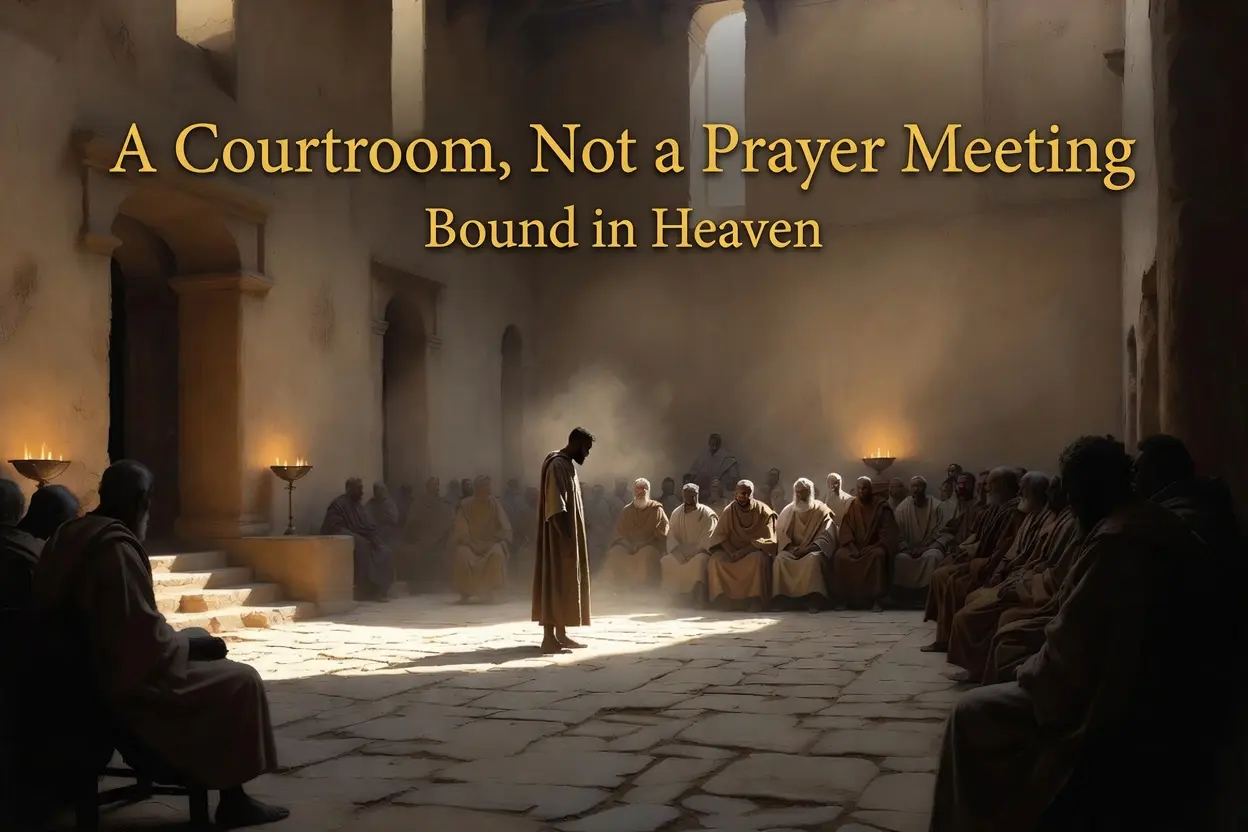
Few verses are lifted out of their setting more cheerfully than the last one in the paragraph. A handful of believers gather for prayer, someone reads it aloud as a kind of benediction, and everyone takes comfort that the Lord has joined the little circle:
"For where two or three are gathered together in my name, there am I in the midst of them." (Matthew 18:20 KJV)
A few feet down the same shelf the companion phrases are put to harder use. Men claim to bind the devil and loose blessings, to bind sickness and loose prosperity, as though the words were a lever fitted to the hand of any believer who learns the technique. Both the comfortable use and the aggressive one make the same mistake. They pull a sentence out of a paragraph, and the paragraph happens to be about something neither group is doing. Matthew 18:20 is not a promise about prayer meetings, and binding and loosing is not a tool for spiritual warfare. Read the whole passage in its own program and a very different thing comes into view — a thing that belonged to Israel's kingdom and was never handed to the Body of Christ at all.
The Paragraph, Not the Sentence
The verse everyone quotes is the floor of a paragraph about discipline, and the paragraph has a shape. Begin at the top:
"Moreover if thy brother shall trespass against thee, go and tell him his fault between thee and him alone: if he shall hear thee, thou hast gained thy brother. But if he will not hear thee, then take with thee one or two more, that in the mouth of two or three witnesses every word may be established. And if he shall neglect to hear them, tell it unto the church: but if he neglect to hear the church, let him be unto thee as an heathen man and a publican." (Matthew 18:15–17 KJV)
This is a procedure, and a legal one. A brother offends; you go privately; if that fails you bring witnesses; if that fails the matter comes before the church; and if he will not hear the church he is put outside it. The middle step is not a casual detail. "In the mouth of two or three witnesses every word may be established" is a quotation of the law of Moses — "at the mouth of two witnesses, or at the mouth of three witnesses, shall the matter be established" (Deuteronomy 19:15 KJV). The whole thing runs on the rails of Israel's law. We are watching a tribunal, not a fellowship hour.
And what follows is the verdict and its authority:
"Verily I say unto you, Whatsoever ye shall bind on earth shall be bound in heaven: and whatsoever ye shall loose on earth shall be loosed in heaven. Again I say unto you, That if two of you shall agree on earth as touching any thing that they shall ask, it shall be done for them of my Father which is in heaven. For where two or three are gathered together in my name, there am I in the midst of them." (Matthew 18:18–20 KJV)
Now the famous verse stands where it belongs. The "two or three" of verse 20 are the witnesses of verse 16. The binding and loosing of verse 18 is the assembly's sentence. The agreement of verse 19 is the agreement that backs the verdict. And verse 20 is the ground of the whole proceeding: the King Himself stands in the midst of the assembly that judges in His name, so that what they bind on earth is bound in heaven. This is a courtroom over which Christ presides, and the promise is that heaven stands behind the court's decision. Read that way, the sentimental use evaporates. The verse was never measuring how many believers it takes to summon the Lord to a prayer circle.
The Keys of the Kingdom
What is this binding and loosing, that heaven should ratify it? The Lord had already defined it, and to whom He gave it:
"And I will give unto thee the keys of the kingdom of heaven: and whatsoever thou shalt bind on earth shall be bound in heaven: and whatsoever thou shalt loose on earth shall be loosed in heaven." (Matthew 16:19 KJV)
Binding and loosing is the working of the keys of the kingdom. It is governmental authority — the authority to declare a thing forbidden or permitted, to admit or to shut out, with heaven honoring the act. These are kingdom keys, given to the kingdom apostles, for the administration of a kingdom that was being offered to Israel. The same men who received the keys are told what office they will one day fill:
"Verily I say unto you, That ye which have followed me, in the regeneration when the Son of man shall sit in the throne of his glory, ye also shall sit upon twelve thrones, judging the twelve tribes of Israel." (Matthew 19:28 KJV)
Twelve thrones, judging twelve tribes. The binding and loosing of Matthew 18 is the near end of that authority and the thrones are the far end — the same governing office, exercised first in the assembly and at last from the throne. It is of a piece with the word the risen Lord spoke to the eleven: "Whose soever sins ye remit, they are remitted unto them; and whose soever sins ye retain, they are retained" (John 20:23 KJV). Remit and retain, bind and loose, the keys and the thrones — all one fabric, and all of it kingdom administration committed to Israel's apostles. None of it is a formula for a believer to bind a demon. To make it that is to take the keys of a king's house and use them as a charm.
Which Church?
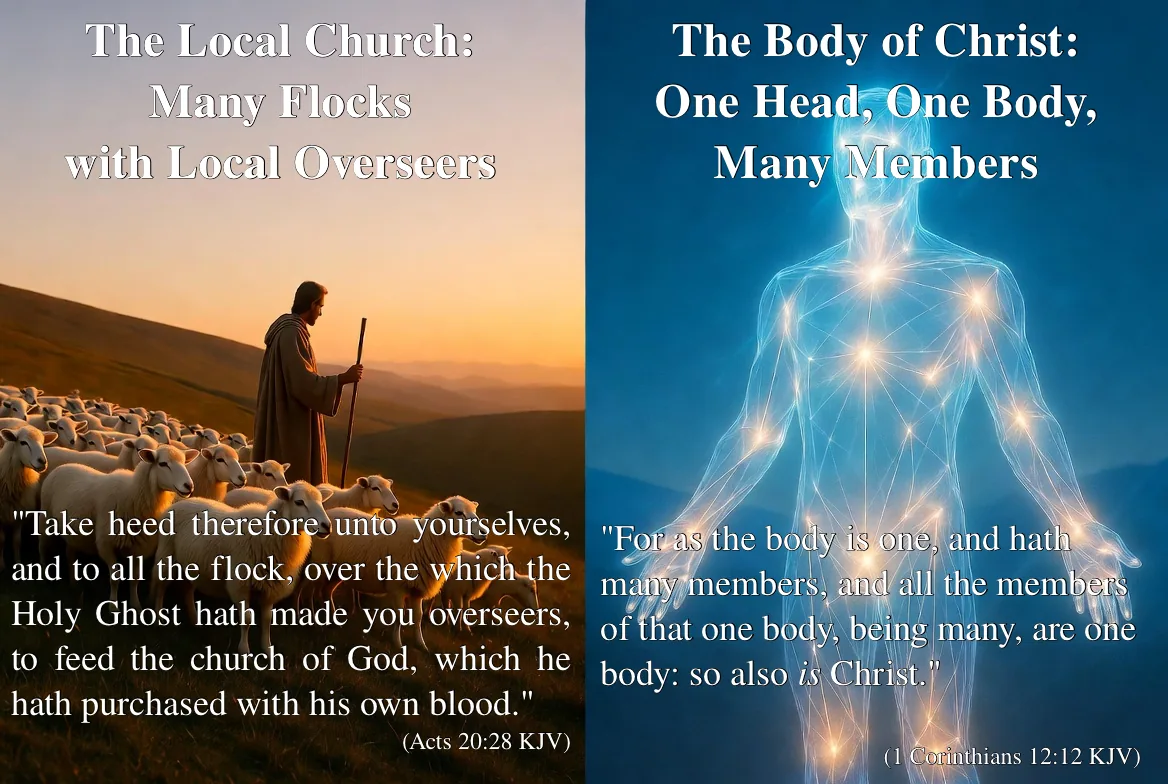
Everything turns on a word we read too quickly. "Tell it unto the church" — and at once the modern reader pictures the Body of Christ, his own congregation, himself. But the word church does not always mean the Body of Christ. Stephen called the congregation of Israel in the wilderness "the church in the wilderness" (Acts 7:38 KJV) — Moses' people under the law, centuries before Paul. The word means an assembly, a called-out company, and Scripture uses it of more than one such company. The Bible itself names distinct assemblies — the church in the wilderness (Israel under Moses, Acts 7:38), the kingdom church gathered out of believing Israel and added to at Pentecost (Acts 2), and the church which is the Body of Christ, made known through Paul (Colossians 1:24). Three assemblies, three messages, three sets of instructions — and only the last is the church God is building today.
Matthew 18 belongs to the middle one. It is the kingdom assembly, the company that holds the keys, that brings a matter before the church and binds or looses with heaven's backing. Its discipline runs on the law of witnesses, it wields kingdom authority, and it culminates in thrones over the twelve tribes. Not one mark of it is a mark of the Body of Christ. The Body is not the assembly Matthew 18 is regulating, any more than it is the assembly that followed Moses through the wilderness. The honest question before any instruction in the Gospels is always the same: who is speaking, to which church, and is it the church God is building now? Ask it here and the answer is settled. The Lord is giving Israel's kingdom assembly its rule of discipline. He is not handing the Body of Christ a manual.
There Am I in the Midst
Then what of the promise itself — Christ in the midst of the gathered? Here a fair objection rises, and it is worth meeting head-on. The kingdom saint had the Spirit abiding in him. Why would he need a separate promise of Christ in the midst of the assembly, if Christ by the Spirit was already in him?
Because the two are not the same thing. The abiding of the Spirit in a man is personal; his own relation to God. The presence of Christ in the midst of a judging assembly is corporate and governmental; the King presiding over a court that acts in His name. One is the indwelling of a saint, the other is the authority standing behind a verdict. A kingdom believer could have the Spirit within him and still need the assurance that, when the assembly convened to bind and loose, the King Himself stood among them to ratify the sentence in heaven. That phrase, in the midst, carries this very weight all through Israel's Scriptures — God in the midst of the camp, in the midst of the congregation, Emmanuel, "God with us" (Matthew 1:23 KJV). It is the language of a divine presence presiding over a people, not the language of the earnest within one heart.
It bears adding what that kingdom indwelling actually was, for it only sharpens the point. Under that program the Spirit's abiding was experiential and could be withdrawn. David prayed, "take not thy holy spirit from me" (Psalm 51:11 KJV); and the Lord said of the Comforter that He "dwelleth with you, and shall be in you" (John 14:17 KJV) — still future, still promised. That is nothing like the permanent, universal sealing of the Body. So even on the individual side, the kingdom saint's indwelling and the assembly's presiding presence are two different things operating at two different levels, and Matthew 18:20 speaks only of the second.
The Body Has No Keys
Cross the line into Paul's epistles and the whole apparatus is gone. Search the letters written to the Body of Christ and you will not find binding and loosing. You will not find tell it unto the church as a tribunal whose verdicts heaven ratifies. You will not find keys of the kingdom, nor thrones, nor the law of witnesses set up as a court of sentence. The Body has no keys. It was never given the kingdom's governing authority, because it is not the kingdom's governing assembly.
This does not mean the Body has no discipline. It means its discipline is of another kind entirely — not the sentence of a court but the correction of a household. Paul does tell the assembly to act against open, unrepentant sin, and his instructions are plain. He tells Corinth to deal with the man living in fornication: "put away from among yourselves that wicked person" (1 Corinthians 5:13 KJV), and he names the aim of even his gravest measure — "To deliver such an one unto Satan for the destruction of the flesh, that the spirit may be saved in the day of the Lord Jesus" (1 Corinthians 5:5 KJV). To deliver unto Satan is not to hand a man over for the adversary to torment; it is to put him out of the assembly's sheltering fellowship and into the open course of this present world, that the loss of that fellowship may bring him to himself. Paul did the same with two named men — "Hymenaeus and Alexander; whom I have delivered unto Satan, that they may learn not to blaspheme" (1 Timothy 1:20 KJV).
A careful reader will have caught an echo here, and it is worth meeting plainly. When Paul tells Corinth to act, he too speaks of the assembly gathered in the Lord's name — "In the name of our Lord Jesus Christ, when ye are gathered together" (1 Corinthians 5:4 KJV) — the very ring of Matthew 18:20. But listen to what the gathering is for. Not to bind a verdict in heaven, but to put a man out. Not to sentence him, but to deliver him to the world's course that his spirit may be saved. The words rhyme; the thing they name does not. Paul takes up no keys and pronounces nothing bound in heaven; he gathers the saints to remove an unrepentant member for his own recovery, and the man's standing is never so much as in question. An echo is not an importation.
And alongside that severest step stand the gentler ones, all of the same family. Withdraw from the disorderly — "that ye withdraw yourselves from every brother that walketh disorderly" (2 Thessalonians 3:6 KJV). Note him and keep no company with him, that he may feel the loss and be ashamed — "note that man, and have no company with him, that he may be ashamed" — yet without ever forgetting what he is: "count him not as an enemy, but admonish him as a brother" (2 Thessalonians 3:14–15 KJV). Mark and avoid the divisive — "mark them which cause divisions and offences contrary to the doctrine which ye have learned; and avoid them" (Romans 16:17 KJV). Reject the obstinate heretic "after the first and second admonition" (Titus 3:10 KJV). Every one of these is corrective, relational, and reversible. None of them is a verdict bound in heaven. The model is not a magistrate passing sentence; it is a father correcting a son.
The One Principle That Carries
One thread does cross the line, and it is worth naming so the distinction is not overdrawn. The requirement of witnesses — that no man be condemned on a single voice — is not peculiar to the kingdom; it is a principle of plain justice, and it is honored in the Body as well. Paul writes, "Against an elder receive not an accusation, but before two or three witnesses" (1 Timothy 5:19 KJV). The principle of the witnesses carries, because fairness is not a thing the dispensations turn on and off.
But notice exactly what carried and what did not. Paul keeps the safeguard of witnesses; he does not erect the tribunal. There is no tell it unto the church that binds in heaven, no keys, no kingdom sentence — only the apostle's settled instruction that an accusation against a leader must be established, and that a man who sins be rebuked "before all, that others also may fear" (1 Timothy 5:20 KJV). The grain of justice common to all of God's dealings remains. The kingdom machinery of Matthew 18 does not. Keeping those two apart is the difference between learning from the whole Bible and borrowing instructions never written to us.
What the Body's Discipline Cannot Touch
There is one more thing the Body's discipline never does, and it marks the deepest difference of all. It cannot reach a man's standing. When Paul puts the fornicator out of Corinth, the aim is still "that the spirit may be saved" — the man is a saved man the whole time, and the discipline cannot unmake it. The members of the Body are sealed: "grieve not the holy Spirit of God, whereby ye are sealed unto the day of redemption" (Ephesians 4:30 KJV). That seal no assembly can break and no sin can void. And the believer's fellowship is itself a possession, given by a faithful God — "God is faithful, by whom ye were called unto the fellowship of his Son Jesus Christ our Lord" (1 Corinthians 1:9 KJV) — not a status the assembly grants and withdraws. What discipline reaches is the man's walk and his practical place among the saints; what it can never reach is his acceptance in the Beloved.
Which is why the whole aim, from first step to last, is restoration. "Brethren, if a man be overtaken in a fault, ye which are spiritual, restore such an one in the spirit of meekness" (Galatians 6:1 KJV). And when the disciplined man at Corinth repented, Paul did not call for a sentence to be lifted but for love to be confirmed: the punishment "inflicted of many" was sufficient, and now "ye ought rather to forgive him, and comfort him, lest perhaps such a one should be swallowed up with overmuch sorrow... confirm your love toward him" (2 Corinthians 2:6–8 KJV). That is the temper of the Body's discipline — grieved, never vindictive; aimed always at recovery, never at a binding sentence in heaven. A court binds. A family forgives.
The Verse Restored
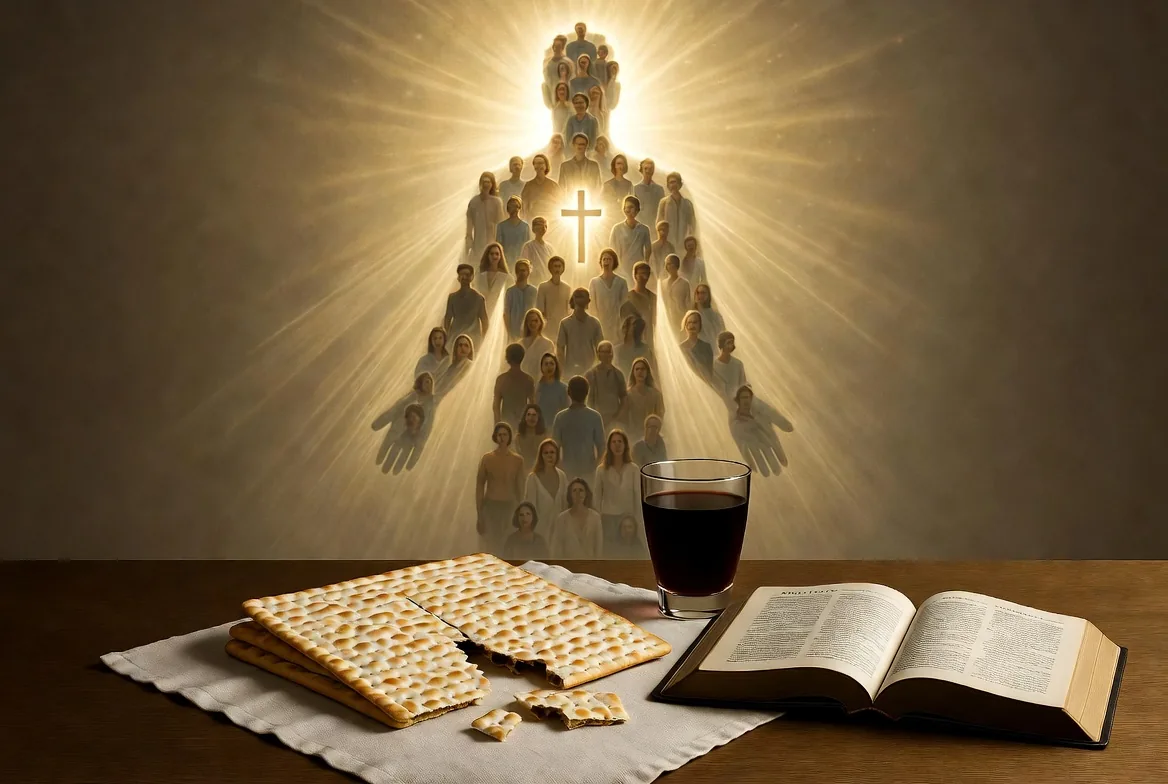
So return the keystone verse to its own house. "Where two or three are gathered together in my name, there am I in the midst of them" is the King's pledge to preside over the lawful judgment of Israel's kingdom assembly and to back its verdict from heaven. It is not a measure of how many believers it takes to bring Christ to a meeting, and it is not a warrant for any man to bind and loose the unseen world. The Body of Christ does not assemble to summon a presence it otherwise lacks. Every member is indwelt already, individually and permanently, sealed unto the day of redemption, complete in Christ and seated in Him. We do not need a quorum to secure the Lord; He never leaves the one, let alone the gathered.
There is real comfort in the verse — far better comfort than the borrowed kind. It tells us what God thinks of an assembly that acts in His name: He stands among them. But the comfort proper to us is greater still, and it does not wait on a count of heads. The same Lord who promised to stand in the midst of Israel's court has, for us, taken up residence within — and from that seat He will never be moved.
© 2026 Edward R. Cross


Comments
No comments yet. Be the first to share your thoughts.
Leave a comment